| نویسندگان | مریم هاشمی,داریوش مددی,فریبا تاج ابادی,سیدمحمدباقر قریشی,نیما تقوینیا |
|---|
| نشریه | Materials Research Bulletin |
|---|
| ضریب تاثیر (IF) | ثبت نشده |
|---|
| نوع مقاله | Full Paper |
|---|
| تاریخ انتشار | 2026-09-09 |
|---|
| رتبه نشریه | علمی - پژوهشی |
|---|
| نوع نشریه | الکترونیکی |
|---|
| کشور محل چاپ | ایران |
|---|
| نمایه نشریه | JCR |
|---|
| کلید واژه ها | CuInSe2 Copper salt Solar cell Simulation |
|---|
چکیده مقاله
This study systematically investigates how different copper precursors affect the structural, optical, electro-
chemical, and electrical properties of spray-deposited CuInSe₂ (CISe) thin films. X-ray diffraction confirms single-
phase, polycrystalline chalcopyrite formation without secondary phases. The copper precursor strongly in-
fluences the microstructure, with CuI-derived films exhibiting the largest grain size (~0.55 μm), compared with
Cu(NO₃)₂ (~0.28 μm) and CuCl₂ (~0.07 μm). All films show high absorption coefficients (>10⁴ cm⁻¹) in the
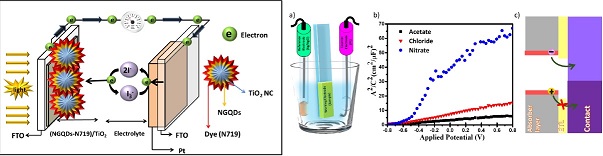
800–1100 nm range, indicating suitability as absorber layers. Mott–Schottky analysis confirms p-type conduc-
tivity, with an optimal acceptor density of 2.4 × 10 ¹ ⁷ cm⁻³ for CuI-based films. Dark current–voltage mea-
surements reveal ohmic behavior and the highest hole mobility (~2.1 × 10⁻² cm² V⁻¹ s⁻¹) for the CuI sample.
SCAPS-1D simulations demonstrate that optimizing the ZnOS window layer improves band alignment,
yielding a simulated efficiency of 17.28%, highlighting the potential of CuI-derived CISe films for efficient thin-
film solar cells.