| نویسندگان | فرهاد جهان تیغ,سیدمحمدباقر قریشی,سمانه مظفری |
|---|
| نشریه | J SOLID STATE ELECTR |
|---|
| شماره صفحات | 1 |
|---|
| شماره مجلد | 20 |
|---|
| ضریب تاثیر (IF) | ثبت نشده |
|---|
| نوع مقاله | Full Paper |
|---|
| تاریخ انتشار | 2020-03-06 |
|---|
| رتبه نشریه | علمی - پژوهشی |
|---|
| نوع نشریه | الکترونیکی |
|---|
| کشور محل چاپ | ایران |
|---|
| نمایه نشریه | JCR |
|---|
چکیده مقاله
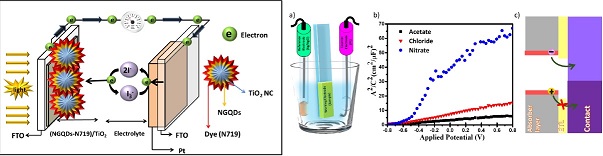
In this research, nanocoral (NC) film of TiO2 was decorated with nitrogen-doped graphene quantum dots (NGQDs, average size
of ∼ 9 nm) and photovoltaic properties were investigated for dye-sensitized solar cell application. TiO2 NCs and NGQDs
synthesized separately using the hydrothermal method and TiO2 NCs were decorated with NGQD solution by spin coating.
FESEM images prove that TiO2 NCs are composed from nanorods, with an average diameter of about 60 nm. Optical characterization
shows that the NGQDs are highly orange-luminescent (emission at 590 nm) and absorb UVand visible light photons.
Using NGQDs together with N719 dye as co-sensitizers led to an improvement in efficiency of DSSC, as investigated by
photoelectrical measurements. The experimental analysis reveals that this improvement arises from enhancement of charge
separation and collection due to the cascaded energy levels because of presence of NGQDs. By addition of NGQDs into TiO2
NC photoanode, we were able to increase the short-circuit current density and efficiency by 40% (from 12.61 to 17.65 mA/cm2)
and 31% (from 5.72 to 7.49%), respectively.